The Ballad of Persse O'Reilly
Finnegans WakeThe Ballad of Persse O'Reilly is a communal song that recasts HCE’s alleged disgrace as a comic fall from power, then carries that story through performance, rumor, and repeated variation. Its refrain invites a crowd to take up the mockery, while the text’s shifting voices and settings make the ballad less a stable account than a public act of transmission.
Composition and public performance
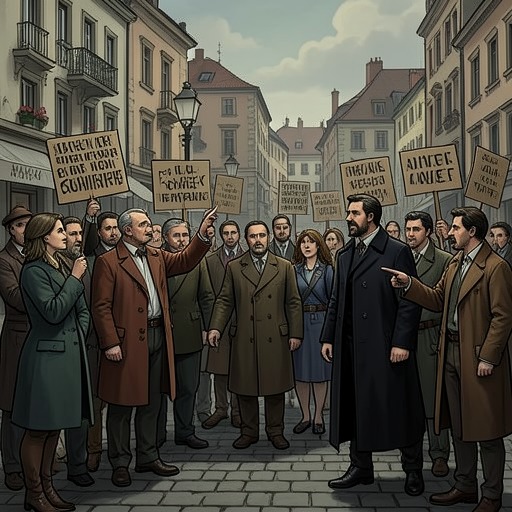
The song is introduced as Hosty’s work, made and sung around a lawn before a crowd. Its opening performance gathers named local groups and performers into a chorus, then plays on uncertainty over the target’s identity: he is variously called Vike, Mike, Llyn, Phin, Lug Bug Dan Lop, Lex, Lax, Gunne, Guinn, Arth, Barth, Coll, Noll, Soll, Will, Weel, and Wall before the singer settles on Persse O'Reilly. The crowd’s answering refrain makes authorship communal as well as individual: Hosty is praised as the man who can rhyme the song, but its repeated responses belong to the assembled voices.
The ballad is not confined to a single singing. A later account places its performance at an old tollgate near Saint Annona's Street and Church, accompanied by flute music and public display. The song is described as spreading from village to village, passing along roads and from one person to another. Its circulation is part of its meaning: each performance renews the story and enlarges its audience.
The fall in the song
The ballad opens by comparing its subject to Humpty Dumpty, who falls with a roll and a rumble and curls up by the Magazine Wall. Its refrain names the wall again, fixing the fall to a recognizable place and making the image easy for a crowd to repeat. The once-powerful figure, formerly a king of the castle, is now kicked about like a rotten parsnip; the song imagines his removal from Green Street to Mountjoy Prison.
The ridicule escalates from public disgrace to apparent irreversibility. The ballad declares that neither the king’s men nor his horses can restore the fallen body, and that no spell in Connacht or hell can raise Cain. The comic fall thus carries a darker implication: the song turns an allegation into a deathlike public verdict, even as its playful rhythms and shifting names keep the target in motion.
Versions, rumor, and uncertainty
The song’s afterlife is not presented as a clean chain of faithful copies. The text says that the story travels through differing accounts, and later invokes a version of the ballad under a variant spelling of its title. Elsewhere, a set of tunes and dances is said to have come down through time in changed social and monetary conditions. Together these recurrences show how the ballad belongs to a wider culture of remembered performance, where a melody or refrain can persist while words, settings, and associations shift.
That instability matches the uncertainty surrounding the underlying accusation. The narrative presents competing testimonies and asks whether reports of outrages were true, fabricated, or only partly carried out. A catalogue of public opinions—including a dustman’s response about a nullity suit, a driver’s judgment of the accused, and a detective’s view that his greatness was his tragedy—makes the case a contest among voices rather than a settled account. The ballad’s certainty of tone therefore contrasts with the uncertainty of the evidence it turns into song.
Recurrence and narrative significance
The ballad’s tune and material recur amid lists of children’s games and familiar songs, including a call-and-response game named for a postman and a game recalling the Battle of Waterloo. Elsewhere, dancing and music return across generations and neighborhoods, suggesting that performance itself is one of the book’s ways of carrying the past forward. The song can be detached from its first occasion, remembered beside other communal forms, and summoned again in a new context.
Its narrative force lies in that passage between allegation and refrain. A fall that may be disputed becomes memorable because it has a place, a comic image, a rhythm, and a chorus; every repetition offers the crowd another chance to name and judge its subject. Yet the same proliferating names and competing accounts prevent the song from fixing a single, fully reliable version of events. The ballad makes public shame durable by making it singable, while its variations expose how unstable that durability is.